Tag Archives: dessert

President Lincoln’s Favorites . . .

I’ve just received a communiqué from our Backstage Baker, currently in San Diego at the La Jolla Playhouse stage managing the WORLD-PREMIERE of a new musical. Please enjoy the following delicious recipe that he featured at his first rehearsal Wine and Unwind:

I am doing a show called “3 Summers of Lincoln” about Abraham Lincoln during the Civil War.

It is well-known that Lincoln had a sweet tooth and that he loved gingerbread. Since he is on the penny. I thought this cookie would be perfect for our first Wine and Unwind. (And the two tablespoons of ground ginger IS correct. These are very flavorful cookies!!!)
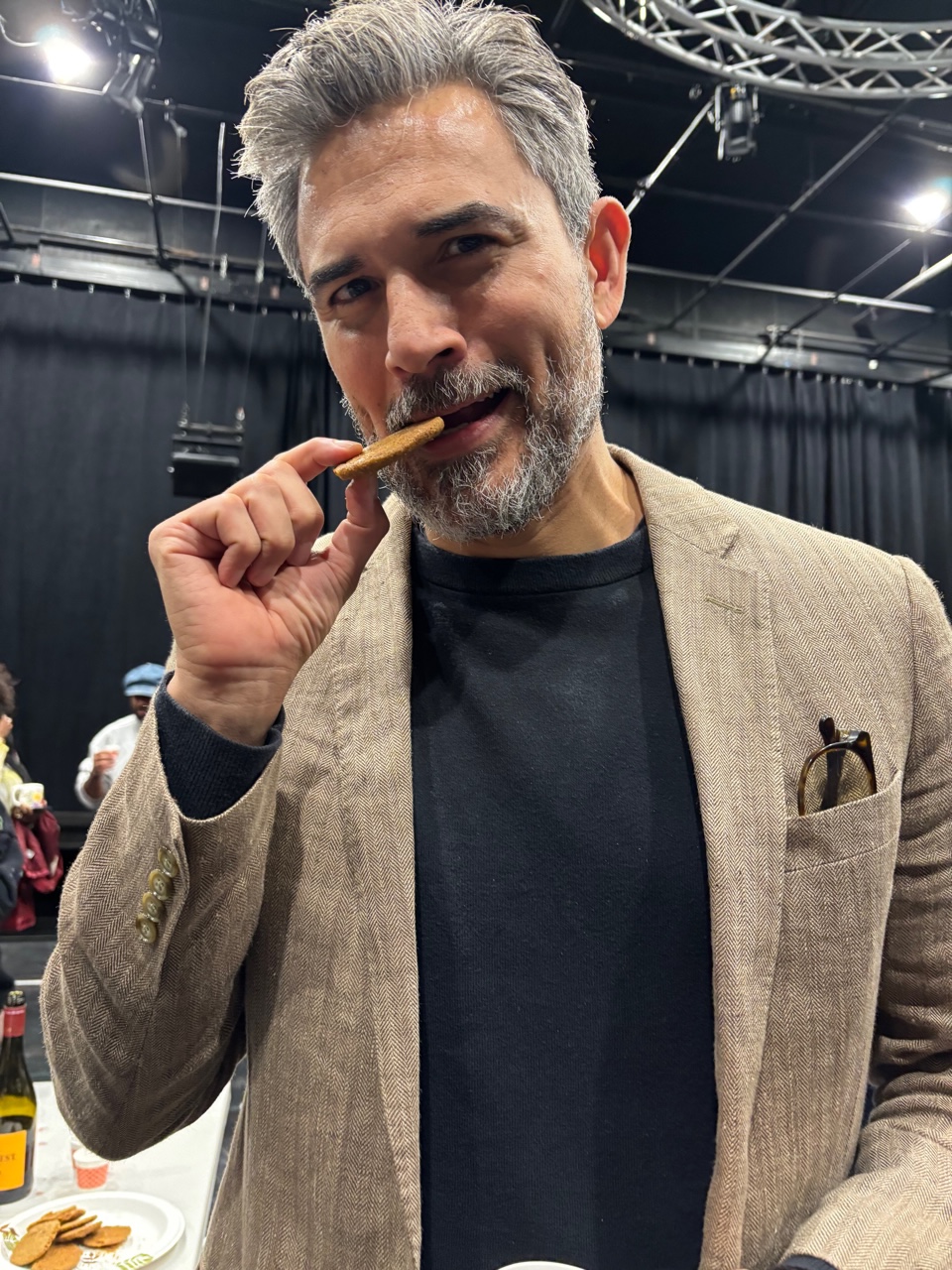
Ivan Hernandez stars as Abraham Lincoln – here he is sampling one of the cookies

Ginger Pennies

Ingredients:

3 cups all-purpose flour
2 tablespoons ground ginger
1 teaspoon ground cloves
1 teaspoon baking soda
3/4 teaspoon salt
1 cup unsalted butter (2 sticks), at room temperature
1 cup dark brown sugar
1/3 cup molasses
1 large egg
1 teaspoon vanilla
Zest of one lemon
3 tablespoons candied ginger, finely chopped
3/4 cup turbinado sugar, for dipping

Method:

1. Mix the dry ingredients: In a bowl, whisk the flour, ginger, cloves, baking soda, and salt together.

2. Make the dough: In a stand mixer with the paddle attachment on medium-low speed, beat the butter and brown sugar together for about 3 minutes, or until smooth. Scrape down the sides of the bowl with a spatula as needed. With the mixer still on medium to low speed, add the molasses, egg, vanilla, lemon zest, and candied ginger, beating until well combined, about 1 to 2 minutes. Gradually add the dry ingredients, mixing on low speed until the dough comes together and is well combined. Scrape down the bowl as necessary.

3. Form the logs: Spread a 14- to 16-inch piece of plastic wrap on a work surface. Spoon about one-third of the dough in a 12-inch-long line on top that is roughly 1 1/4 inch thick, leaving space at each end to wrap the plastic. Encase the dough in the plastic wrap and roll it back and forth to form it into a roll. Repeat with the remaining dough. Place the logs on a baking sheet or tray that will fit in your freezer, and chill for 1 to 2 hours, or overnight. The dough will keep in the freezer for 3 months or longer.

4. Preheat the oven: Once the dough has chilled, preheat the oven 350°F. Line several baking sheets with parchment paper.

5. Slice the cookies and coat them in sugar:  Pour the sugar into a shallow bowl. Slice the rolls into 1/4-inch-thick cookies and press both sides of each cookie into the sugar. Place them on the baking sheets, about 1-inch apart

6. Bake the cookies: Bake the cookies for 10 to 12 minutes, or until the bottoms of the cookie are lightly browned. Cool on the baking sheet. They will keep for at least two weeks in a tightly closed cookie tin.

Emmett Otter and Nutella Brownies

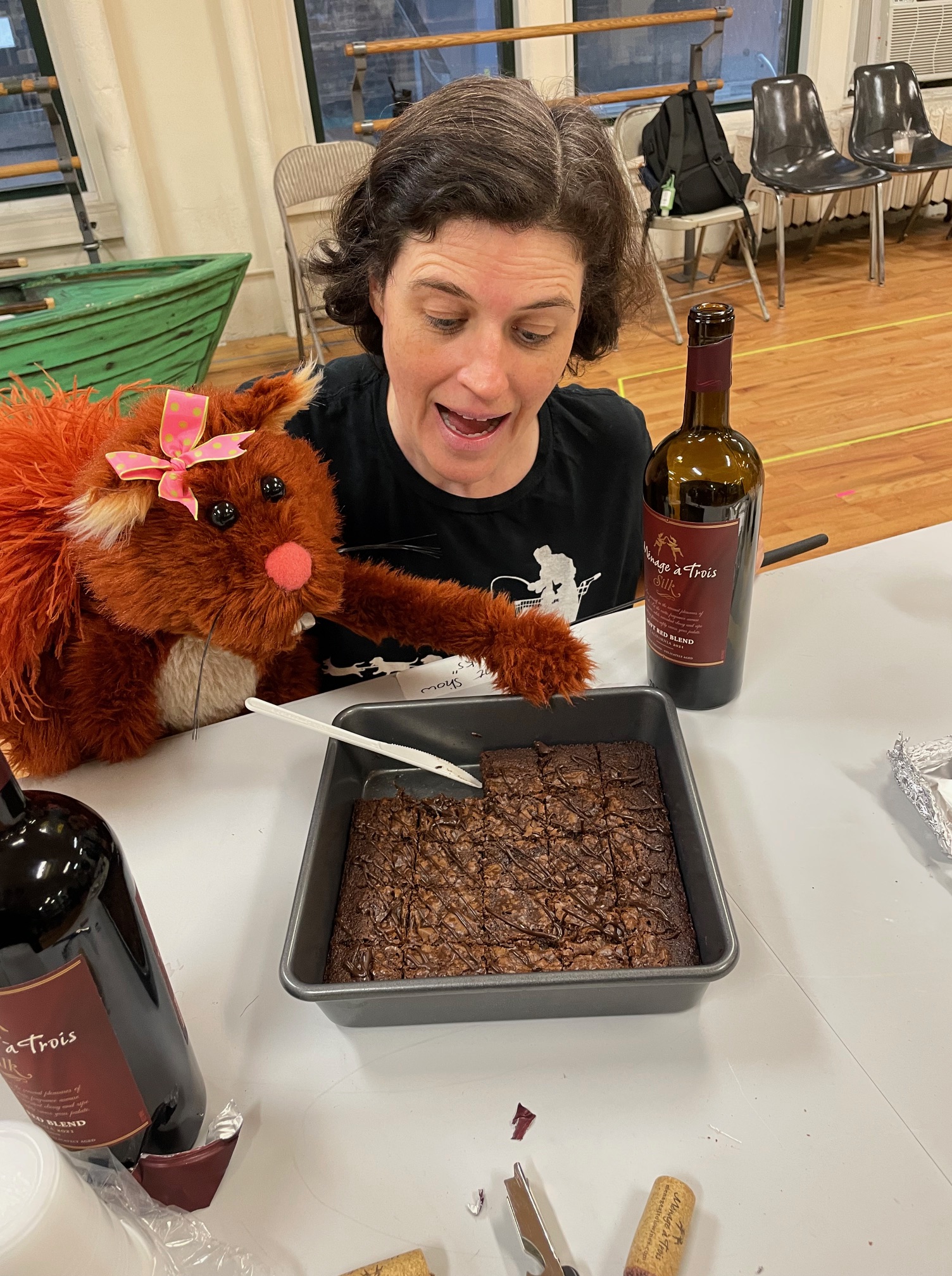
Nutella the Squirrel about to bite into a brownie
(and, it seems, to enjoy a glass of Menage a Trois red.)

Our Backstage Baker is in Chicago for this holiday season, with “Emmet Otter’s Jug Band Christmas.

With Jim Henson puppets, music by Paul Williams, direction/choreography by Tony Award-winner Christopher Gatelli, and host of other top drawer Broadway talent, if you’re in Chicago, this is a don’t-miss holiday treat!!  

Get your tickets here – “Emmet Otter’s Jug Band Christmas” only runs through December 31, 2023.

(Confession here:  I’d never HEARD of Emmet Otter nor his Jug Band Christmas, but my husband immediately began singing songs from it when James told us of this project.  Chalk it up to my deprived childhood, where I was only taken to the Met Opera, Shakespeare at the Delacorte, and any and all plays by Eugene O’Neill.)

This recipe is particularly appropriate to the show, since one of the characters is named Nutella.  (I also understand there’s a song called “Barbeque” in the show, so expect some sort of BBQ sauce-flavored dessert coming up.  If anyone can make something toothsome out of BBQ sauce, it’s our Backstage Baker.)

So please to enjoy this hazelnut and chocolate spread-based delight – it’s probably one of the simplest brownie recipes you’ll ever find. 

And if you can’t make it to Chicago this season, here’s a video of a video off a television with 1977-technology of the original television show for your holiday enjoyment.  

Nutella Brownies (courtesy of New York Times Cooking)

Ingredients

  • Non-stick cooking spray
  • 1 1/2 cups/442 grams chocolate hazelnut spread (such as Nutella)
  • 2 large eggs, room temperature
  • 3/4 teaspoon kosher salt (such as Diamond Crystal)
  • 1/3 cup/43 grams all-purpose flour

Directions

1. Heat the oven to 350 degrees. Grease an 8-inch square baking pan, preferably metal (see Tip), with non-stick cooking spray and line with a long sheet of parchment paper that extends over two opposite sides of the pan.

2. Whisk the Nutella, eggs and salt in a large bowl until smooth. Gently fold in the flour with a flexible spatula, just until the last streak disappears.

3. Scrape the batter into the prepared pan and bake for 22 to 25 minutes, rotating at the halfway point, until crackly-topped and slightly puffed. A wooden skewer or cake tester inserted in the center should come out just clean. Try not to overbake, as these brownies dry out quickly.

4. Let cool to room temperature before lifting the brownies from the pan with the paper overhang, slicing into 9 squares and serving. Brownies will keep tightly wrapped at room temperature for up to 3 days and in the freezer for up to a month.

TIP

Glass does not conduct heat as well as metal, so it can cause baked goods to cook unevenly and requires an increase in cook time. If using a glass pan, increase the bake time to 37 to 40 minutes, and expect some variation in texture.

Anney Ozar, the human behind the puppet

Hoska, a Latus Family Recipe

So, what to do with all those egg yolks you were left with after making the meringues from our last post?  Well, one thing James likes to do is make a traditional eastern European Christmas/Easter bread called hoska.  A fancy-looking braided bread, James learned to make this with his mother in their Milwaukee kitchen.   He first shared it backstage with his colleagues at the Shakespeare Theatre in Washington, DC at an Easter potluck during a run of The Beggar’s Opera.  “We also did an Easter Egg hunt on the Derek McClain-designed set.  There were lots of piles of rubble and debris which gave us perfect places to hides the eggs.”  I have to wonder if one or two weren’t found until sometime during the show that night!

For all you theater folks out there, you know how the holidays go – generally we have MORE shows.  And especially in regional and Off-Broadway shows with limited runs, you often find yourself eating a potluck holiday meal backstage between shows.  James recalls this Easter potluck being one of many held during the run.  “I usually brought dessert, which is how the cheesecake bake-off began (more on that in a later post.)  But for Easter, of course I brought hoska.”

I give you James’ family recipe with all its charming, old country instructions (to make the dough rise, it recommends putting a piece of buttered waxed paper over the bowl, placing a tea towel over the waxed paper and then placing the covered bowl under a feather pillow.  Really James?  Really??)  But I’ll also tell you that I’ve halved the recipe and made this dough very successfully in my bread machine.

Hoska (Braid) Bread

Makes two braided loaves

Ingredients:

2 cups milk
½ cup plus 1 teaspoon sugar
1 cake yeast
1 cup butter
2 teaspoons salt
8 cups all-purpose flour, sifted
5 egg yolks
1 whole egg
¼ teaspoon mace
¼ teaspoon lemon rind

Method:

1.  Place 1/2 cup lukewarm milk in a small bowl and mix in yeast cake with 1 teaspoon sugar.  Let bubble for about 30 minutes.
2.  Heat  1 1/2 cups of milk and add 1 cup butter, 2 teaspoons salt, and ½ cup sugar to hot milk.  Mix thoroughly with a spoon until butter is completely melted.
3.  In a large mixing bowl put in 4 cups sifted flour.  Make a well in the center of the flour in bowl,  add 4 egg yolks, plus 1 whole egg, 1/4 tsp. mace and 1/4 tsp. lemon rind. Add yeast mixture and milk mixture to flour & eggs. Mix well with mixer. Then add 4 more cups flour. Knead by hand until flour is well blended or use your Mixmaster hooks to knead the dough. Let the dough rise for about 1-2 hours until doubled in size. (Tip for making the dough rise. Put a piece of buttered waxed paper over the bowl and place a tea towel over the waxed paper. Place the covered bowl under a feather pillow.)
4.  After dough rises, divide dough into two portions.  Each portion will make one loaf  (FYI, each hoska consists of two braids.)  Working with one portion of dough, divide it into two parts, one part a little bigger than the other. Cut the bigger portion into 3 pieces. Roll each piece about 10 to 12″ long then form into a braid. With the smaller piece of dough, also divide that into 3 pieces but take a walnut size ball off first and reserve than. This time roll each piece only about 8″ long before making into a braid. Place the smaller braid on top of the larger. Take the walnut sized ball and roll that out into a long piece a few inches longer than the hoska. Lay this rope-like piece of dough on top of the other two and tuck the ends under the ends of the bread. You now have one hoska made. Do the same with the other portion of dough.  Remember, this makes two braided loaves.
5. Let rise about 1/2 hour. Brush the hoska with 1 egg yolk and 2 tablespoons of cold water for a golden brown finish just before baking.
6. Bake at 350 degree oven for 30 minutes.

**Caroline’s note:  I’ve halved this recipe, warmed the milk and melted the butter separately, then put all the ingredients in my bread machine at once.  Then, I set it on the ‘Dough’ setting for about two hours and proceed with step #4 above. 


Meringue, meringue!!

The Skriker, March 1996

The first show James and I worked on together was a crazy complicated piece by Caryl Churchill called “The Skriker.”  To this day I’m not really sure if it was a play or a musical or even what it was all about.   But it was memorably dramatic and edgy and out there. It started with the unforgettable entrance of Jayne Atkinson (the Skriker) breaking through the stage floor, encased in a rubber cocoon and sitting on an armchair covered in real live grass.  She sat on top of the 12’ scissor lift and recited a 4 ½ page monologue that started with:  “Heard her boast beef a roast beef eater, daughter could spin span spick and spun the lowest form of wheat straw into gold, raw into roar, golden lion and lyonesse under the sea, her in dungeonesse under the castle, spindling swindling dwindling Gwendolyn wheedling.”   WTF??

Directed by the intrepid Mark Wing-Davey, and presented in the Public Theater’s Newman Theater, it was a wild and woolly evening of theater.  Nothing was out of bounds. Mark set the tone immediately and our rehearsals began with a leisurely game of koosh ball and ended up including field trips to the Bronx Zoo and Bellevue.  James’ rehearsal reports (which for some reason I still have) are full of delightful little oddities:

 “Does anyone have a newborn baby we could use in rehearsal for a few hours?  We’ll take good care of it, but the child shouldn’t be sensitive to being called a slitty-eyed changeling.”

and

“In the bar scene, the Skriker wants a scotch and soda (don’t we all.)  We’ll need an appropriate glass, ice and spoon.”

and

“The Fair Fairy will only vomit vegetable soup.  (Actor is vegetarian.)”

As I recall, there was a lot of food (and mud and water and slime!) used throughout the show.  One rehearsal report noted that: “For the Glamour Banquet Scene, Mark wants to use brains (from British cows, of course!), eyeballs (real or fake – you decide), edible ladyfingers and edible meringues.”

Oh that Glamour Banquet!  I remember it vividly.  The banquet table was laid directly on a large section of the stage deck that lowered so we could quickly we dress it in the trap with the above-mentioned brains, etc., and then raise it up to table height.    The number itself was deafening, full of subwoofer and strobe, and the lyrics went something like this:

Meringue meringue!  
Meringue meringue!  
Meringue utang!  
Welcome homesick
drink drank drunk
avocado and prawn cockfight cockup cocksuck
red wine or white wash
champagne the pain is a sham pain the pain is a sham
fillet steak fill it up stakes in your heart
meringue  utang
black coffee fe fi fo fum

Again, not to sound like a complete Philistine, but WTF does any of this mean??  I still haven’t a clue.

But, I think you can see where this is going – a recipe for meringues!  Meringues were, in fact, my first introduction to the Backstage Baker.  James made them all the time for the Skriker cast and crew, and took the mystery out of meringue for me.  He taught me that meringues are not scary at all, and actually quite simple to make.  Just make sure your beaters are scrupulously clean and don’t try to make these on a humid rainy day.

The recipe below got a lot of use over the recent Christmas holidays.   But you can easily enjoy these year round.   Sometimes I’ll switch out the candy canes and substitute mini-chocolate chips.  But these are also perfectly good without any additions at all.   Even better, they’re eminently suitable for the gluten-free!  (Soon we’ll post a recipe that uses all those egg yolks you’ll be left with.)

Peppermint Meringues

Ingredients:

2 egg whites
1/8 teaspoon salt
1/8 teaspoon cream of tartar
1/2 cup white sugar
2 peppermint candy canes, crushed

Method:

1.    Preheat oven to 225 degrees F.  Line 2 cookie sheets with foil or parchment paper. In a large glass or metal mixing bowl, beat egg whites, salt, and cream of tartar to soft peaks. Gradually add sugar, continuing to beat until whites form stiff peaks. Drop by spoonfuls 1 inch apart on the prepared cookie sheets.  (I like to use a pastry bag or just a zip-top bag with a corner cut out to squeeze the mixture through.)  Sprinkle crushed peppermint candy (if using) over the cookies.  If using mini-chocolate chips, gently fold them into the mixture before spooning onto cookie sheet.
2.    Bake for 1 1/2 hours in preheated oven. Meringues should be completely dry on the inside.   (You’ll just have to eat one to test this.)  Do not allow them to brown. When they seem done, turn off oven. Keeping oven door ajar, let meringues sit in the oven until completely cool. Loosen from foil with metal spatula. Store loosely covered in cool dry place for up to 2 months.